Translate demand into production
Check available finished goods, reserve stock, and create manufacturing orders for the shortage using a multi-level bill of materials.
Web Development / Manufacturing ERP
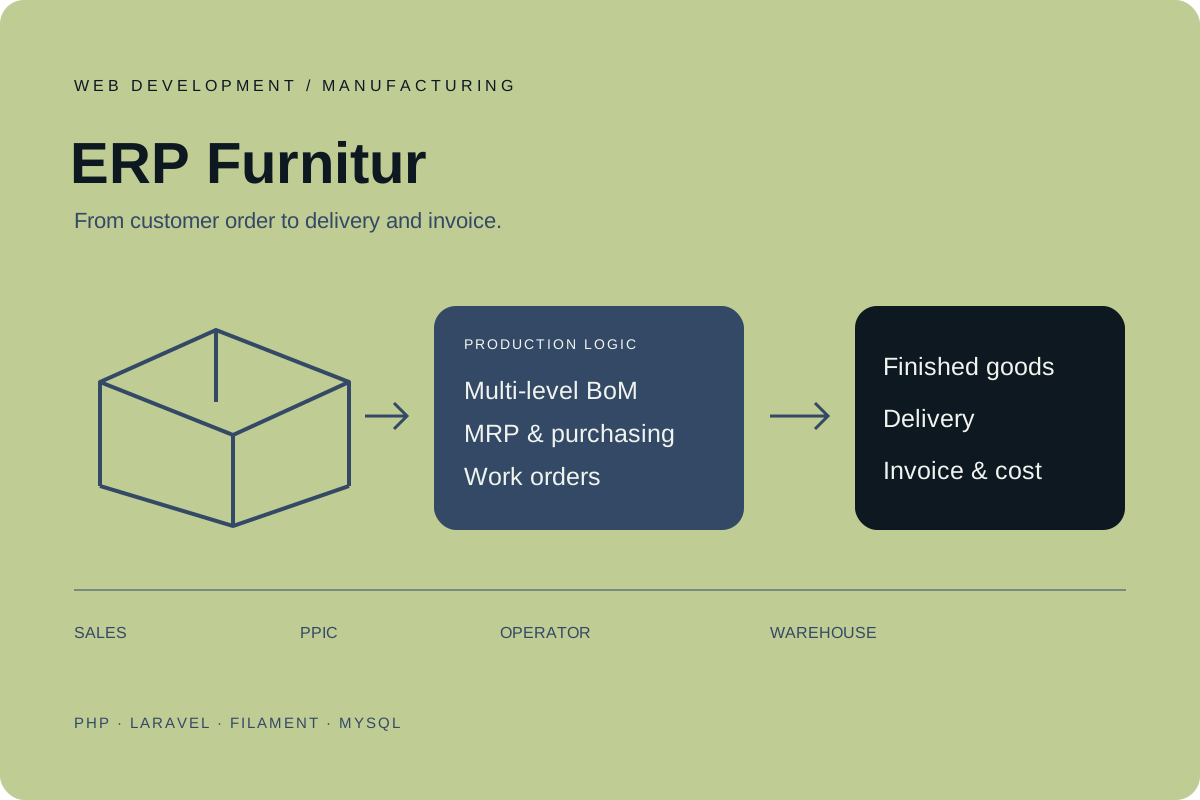
A Laravel manufacturing ERP case study connecting customer orders, multi-level bills of materials, MRP, production, inventory, delivery, and invoicing.
The context
Kayu Jati ERP is a portfolio manufacturing case study for a fictional small furniture factory. Its specification follows make-to-order and make-to-stock workflows, linking each customer order to material requirements, work orders, inventory movements, production cost, and delivery.
Try the workflow / Interactive example
Change the quantities to see how available stock and production share the order.
Illustrative demo with synthetic quantities. This simplified stock-allocation example runs in your browser; it does not connect to the ERP or create real orders.
The supply plan
Reserve 12 chairs from available stock and plan production for the remaining 12. The 8 chairs reserved for other orders stay untouched.
Available stock = on hand − existing reservations.
Production required = order − stock allocated to this order.
System requirements / Use cases
Explore who uses each workflow, what starts it, and the outcome defined in the specification.
Select a step to explore who uses it and what it produces.
Sales
When: A customer places an order with a requested delivery date.
Expected outcome: The order has a traceable production requirement and delivery reservation without allocating the same stock twice.
Read the full use case ↓Production planning and inventory control (PPIC)
When: A new furniture product or production version is prepared.
Expected outcome: A consistent multi-level material and routing plan supports manufacturing and standard cost calculation.
Read the full use case ↓PPIC, purchasing, and warehouse
When: Open production demand or reorder rules reveal a shortage.
Expected outcome: Missing supply is linked back to demand, while purchase confirmation stays with the purchasing role.
Read the full use case ↓Production operator and PPIC
When: A manufacturing order has the materials needed to start.
Expected outcome: Finished output, material usage, and production exceptions are recorded against the originating manufacturing order.
Read the full use case ↓Warehouse and sales
When: Finished goods are ready to leave the factory.
Expected outcome: Shipment and billing remain aligned, with an order-to-delivery-to-invoice document trail.
Read the full use case ↓The following scenarios summarize the system requirements (1 November 2026). They describe the intended business behavior; they are not a completion checklist for every requirement.
When A customer places an order with a requested delivery date.
Expected outcomeThe order has a traceable production requirement and delivery reservation without allocating the same stock twice.
Requirements: FR-401–405
When A new furniture product or production version is prepared.
Expected outcomeA consistent multi-level material and routing plan supports manufacturing and standard cost calculation.
Requirements: FR-201–207
When Open production demand or reorder rules reveal a shortage.
Expected outcomeMissing supply is linked back to demand, while purchase confirmation stays with the purchasing role.
Requirements: FR-601–606
When A manufacturing order has the materials needed to start.
Expected outcomeFinished output, material usage, and production exceptions are recorded against the originating manufacturing order.
Requirements: FR-501–508
When Goods move, are reserved, or are physically counted.
Expected outcomeThe stock card explains receipts, consumption, reservations, and adjustments instead of relying on direct balance edits.
Requirements: FR-301–305
When Production needs a feasible schedule or a completed order needs a cost review.
Expected outcomePlanning and cost review show where production uses capacity and where actual cost differs from the standard.
Requirements: FR-701–704, FR-801, FR-802
When Finished goods are ready to leave the factory.
Expected outcomeShipment and billing remain aligned, with an order-to-delivery-to-invoice document trail.
Requirements: FR-803, FR-804
The specification covers manufacturing, inventory, purchasing, sales, and invoicing. Full general-ledger accounting, HR/payroll, multi-company operations, quality control, and machine maintenance are outside this case study's scope.
Requirement source
Spesifikasi Sistem ERP Manufaktur — Studi Kasus Pabrik Furnitur
View specification · repository access requiredThe approach
Check available finished goods, reserve stock, and create manufacturing orders for the shortage using a multi-level bill of materials.
Use MRP suggestions to purchase missing materials, schedule operations by work-center capacity, and record actual consumption, time, and scrap.
Validate deliveries, invoice the quantities shipped, and compare standard production cost with actual cost.
Inside the repository